PATANJALI'S YOGA SUTRA by SHYAM RANGANATHAN
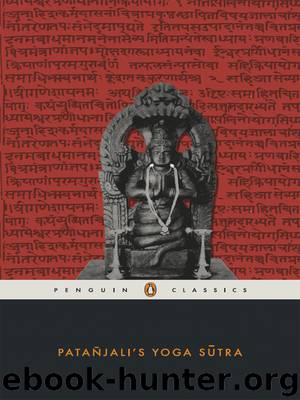
Author:SHYAM RANGANATHAN [Ranganathan, Shyam]
Language: eng
Format: epub
ISBN: 9788184750096
Publisher: Penguin Books Ltd
Published: 2012-12-17T05:00:00+00:00
Book III
Vibhūti-pāda
(1)
deśa-bandhaś-cittasya dhāraṇā
deśa = country, location, region
bandhaḥ = fastening, binding
cittasya = of or among mentality (thinking, thought), intellect, ego, senses
dhāraṇā = fixing attention
Concentration binds the mind on to a single area.
The third book is called the ‘Vibhūti-pāda’ or the ‘Book on Powers’. This book does not contain the first discussion of the powers that the yogi gains through practice. Nor does this book begin cleanly with a new topic. In Book II, devoted to the topic of practice, Patañjali had introduced the notion of the eight limbs of yoga. The eight limbs of yoga are ancillaries that are designed to aid the yogi in her quest to have her true self abide in her own nature. The first five of the limbs are listed in order of interiority. The first of the limbs, the yama rules, are so rudimentary that Patañjali does not even list them in his synopsis of the practice in yoga at the outset of Book II. He believes that they are obligatory, self-imposed vows that all people must practise, whether they practise yoga or not. The four other limbs discussed in Book II are far more specific to the practice of yoga, though we noted that it is possible to disengage some practices (like tapas) from the overall project of yoga in such a manner that it is distinctly unyogic, or hardly yogic. The remaining three limbs of yoga can only be practised by someone who has made great advances on all the other limbs of yoga. Patañjali thus calls these three practices jointly saṃyama or the perfect constraint (of mind).
The present sūtra begins where the previous book closed—elaborating on the limbs of yoga. This sūtra elaborates on the nature of the first of the three interior limbs of yoga: dhāraṇā. Dhāraṇā is the practice of turning the attention of the mind to a specific place, item or thing. It is a meditative practice that can only be attempted after āsana, prāṇāyāma and pratyāhāra have all, in their turn, been perfected. These in turn presuppose significant advances in the foundational limbs—the yama-s and niyama-s. Dhāraṇā is not an end in itself. It leads to other meditative feats, most important of which is dhyāna.
(2)
tatra pratyayaika-tānatā dhyānam
tatra = in that (location), there
pratyaya = condition (from the verb root i = ‘to go’ + prati ‘against, back’)
eka = one
tānatā = continuous, uninterrupted succession
dhyānam = reflection, especially profound and abstract spiritual meditation
In that is the condition for the singular, uninterrupted reflection of a profound spiritual character (dhyāna).
Patañjali had recognized the importance of dhyāna at an earlier point. It is useful in helping yogis overcome the residual dispositions that remain after the yogi had undertaken the psychoanalytic exploration into the historical root of a present aversion (Yoga Sūtra II.11). Even after tracing present aversion back to its root and abandoning it in its subtle form, there can remain much karmic baggage that the yogi cannot simply wish away. This is because our karmic dispositions are genuine, real, unimagined features of our
Download
This site does not store any files on its server. We only index and link to content provided by other sites. Please contact the content providers to delete copyright contents if any and email us, we'll remove relevant links or contents immediately.
| Anthropology | Archaeology |
| Philosophy | Politics & Government |
| Social Sciences | Sociology |
| Women's Studies |
The remains of the day by Kazuo Ishiguro(9000)
Tools of Titans by Timothy Ferriss(8396)
Giovanni's Room by James Baldwin(7346)
The Black Swan by Nassim Nicholas Taleb(7130)
Inner Engineering: A Yogi's Guide to Joy by Sadhguru(6796)
The Way of Zen by Alan W. Watts(6614)
The Power of Now: A Guide to Spiritual Enlightenment by Eckhart Tolle(5783)
Asking the Right Questions: A Guide to Critical Thinking by M. Neil Browne & Stuart M. Keeley(5775)
The Six Wives Of Henry VIII (WOMEN IN HISTORY) by Fraser Antonia(5515)
Astrophysics for People in a Hurry by Neil DeGrasse Tyson(5190)
Housekeeping by Marilynne Robinson(4449)
12 Rules for Life by Jordan B. Peterson(4305)
Ikigai by Héctor García & Francesc Miralles(4275)
Double Down (Diary of a Wimpy Kid Book 11) by Jeff Kinney(4273)
The Ethical Slut by Janet W. Hardy(4253)
Skin in the Game by Nassim Nicholas Taleb(4250)
The Art of Happiness by The Dalai Lama(4130)
Skin in the Game: Hidden Asymmetries in Daily Life by Nassim Nicholas Taleb(4007)
Walking by Henry David Thoreau(3962)
